Anyone who has already found a few records of their ancestors knows the situation: the column says "Haus No. 22" or "č. 22", and next to the name is the village. The number repeats at the baptisms of the children, at the daughter's wedding and at the grandfather's burial. Most people skip it. Yet it is exactly the house number (in Czech: číslo popisné) that links the parish register to other sources: to a map, to the land register, to the census. The name is spelled differently every time; the number stays.
Where house numbers came from
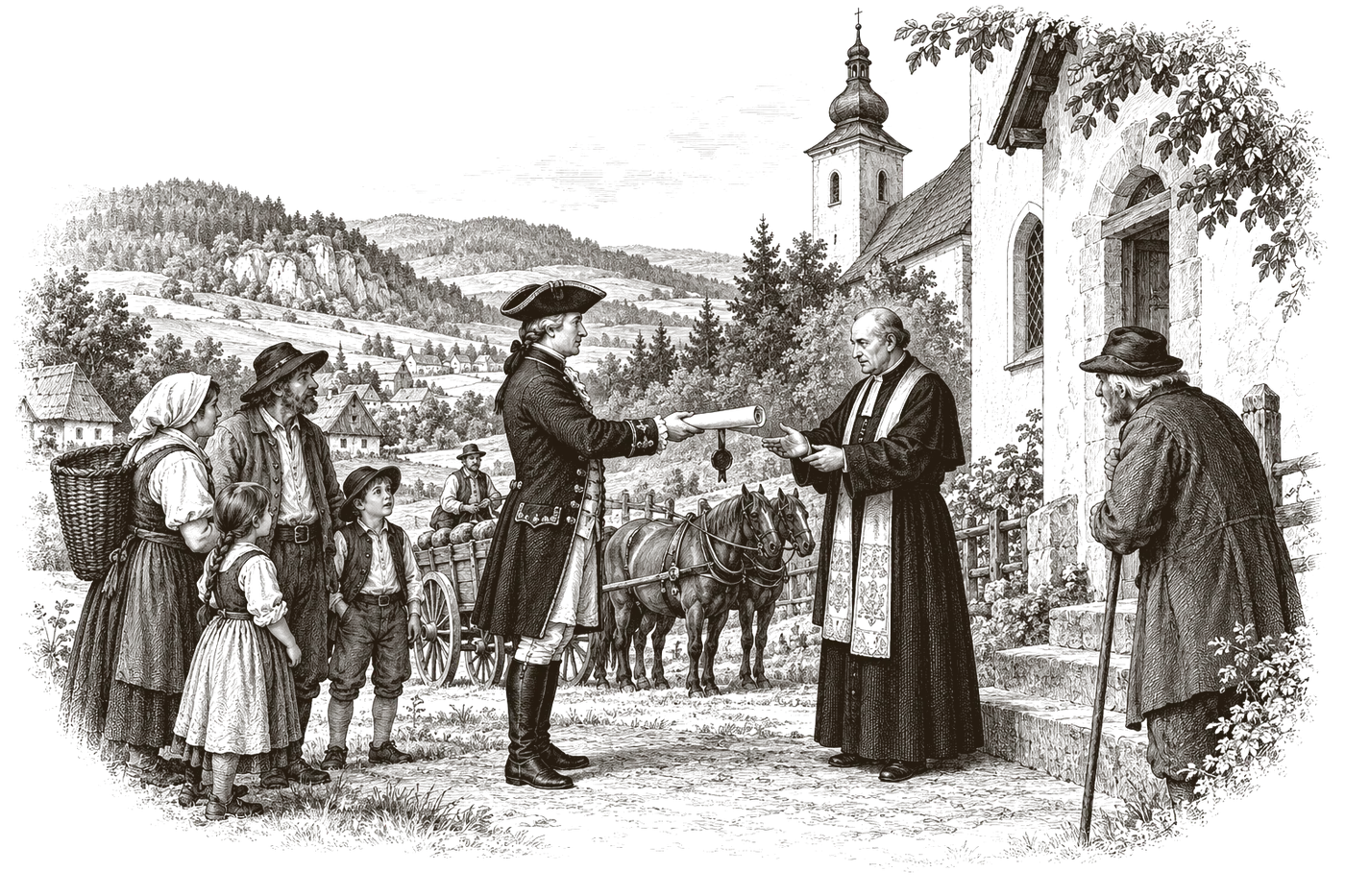
House numbers are older than you would think. They were introduced by a decree of Empress Maria Theresa of 10 March 1770, together with a great census of the population. The census had a mainly military purpose: the state wanted to know how many men it could call up and how many horses and oxen it had. Commissions went from village to village, each with an officer and a district official with their clerks.
The empress decided how the numbering was to be done two days before the decree was issued. The numbers were not painted on plates but in black paint directly above the door. Arabic numerals were used, usually with the prefix "No", so that nobody would mistake them for a year. And the whole village was numbered from one, not street by street. Number 1 usually went to the first house the commission came to on entering the village, in some towns to the castle or the seat of the lord. The order of the numbers still shows which way the commission walked. Houses of Jewish owners were marked separately, with Roman numerals.
The numbers found their way into the registers gradually from the 1770s, and the tables of Emperor Joseph II of 1784 made them permanent. How the records changed then, we describe in the article on the year 1784.
Is it still the same house?
Usually yes, and that is a stroke of luck for the search. House numbers turned out to be unexpectedly durable. The Austrian historian Anton Tantner, who studied the numbering of 1770, points out that in the Czech Republic it is still valid in many villages today and appears on people's identity cards.
But the sequence of numbers got mixed up over time. A new house received the next free number in the row, even if it stood at the opposite end of the village. When two houses were joined, one number disappeared. So in small villages it is often true that the lower the number, the older the house. Whole villages were renumbered rarely, because the authorities knew what confusion it would cause in the books, but it did happen: the first wave of renumbering took place from 1805 to 1815, and in towns numbers changed later as well. So always check a number from before 1805. When military officials wanted to renumber Brno in 1818, the town council agreed only for the suburbs and refused for the inner town.
Whether today's number matches the number in the register, you check on a map. In the online land registry (Nahlížení do katastru nemovitostí) you find today's plot by the house number and then compare it with the old map.
A map with every building on it
That old map is called the stable cadastre (in Czech: stabilní katastr). Emperor Francis I ordered it in a decree of 23 December 1817 to make the land tax fairer. Surveyors then measured every plot: in Moravia from 1824 to 1836, in Bohemia from 1826 to 1843. The maps are at a scale of 1:2880, so every house, barn and garden is visible.
For family historians there are two versions. The imperial imprints (císařské otisky) are hand coloured copies that went to Vienna as the control copy. The indication sketches (indikační skici) were working copies into which the holders of the plots and the type of land were written during the so-called indication, and unlike the imprints they have the house number written next to each building. On the coloured maps the buildings are distinguished: combustible, mostly wooden, in yellow; non-combustible, brick or stone, in crimson. So at first glance you can see whether your ancestors' house was built of wood or of brick.
The maps can be viewed free of charge in the Archiv application of the Czech Office for Surveying, Mapping and Cadastre. You enter the village, click into the map, and the available sheets appear on the right. The indication sketches for Moravia are kept in the Moravian Land Archives in Brno (collection D 9 Indication sketches), for Silesia in the Land Archives in Opava.
The farmstead and its holders
A rural holding with fields was called a grunt, a farmstead. By its size the farmers were called full farmers, half-farmers and quarter-farmers (celoláník, pololáník, čtvrtláník, in German records Ganzlähner, Halblähner, Viertler), according to how much of a lán, the old unit of farmland, they held. Whoever had only a cottage with no fields or a scrap of garden was a cottager, in Czech domkář, in German Häusler. You find these words in the register right after the name, and by themselves they tell you how the family lived.
But a peasant did not own the farmstead the way we own a house. It belonged to the lord of the manor, and every transfer had to be recorded in a book by the manorial office. This is how the farmstead books came about, kept in the archives today as land registers (pozemkové knihy). In them you find the names of the holders, the price at which they took over the farm, instalments, debts, the shares of siblings that the new farmer had to pay out, and often marriage contracts. The manors kept them until 1850, when their offices were abolished; after that the district courts took the books over.
Here is a sample from the land register of Hostěnice near Brno, started in 1795. Every house has its own page in the book. For house no. 22 the oldest record is this:
Land register of Hostěnice, house no. 22, record of 1782
Besitzer. Tomas Wachač im Jahre 782 mit der Wittib nach dem Jakob Řičanek erheurathet um … 100 f. [vlevo: Gewährbuch de ao 782, Gewährbuch No 2 fol. 152]
Holder: Tomáš Wachač, who in 1782 married into the farm through the widow of Jakub Říčánek, for 100 guilders. On the left a reference to an older book of 1782, book no. 2, folio 152.
Jakub Říčánek died and his widow married again. The farm thereby passed to the new husband, Tomáš Wachač. If the family looked for the Říčáneks only in the parish register, the line would vanish here. But sixteen years later the land register goes on:
Land register of Hostěnice, house no. 22, record of 1798
Joseph Řižanek im Jahre 798 von seinem Stiefvater Thomas Wachač … übernommen um … 300 f. [vlevo: Gewöhrbuch No 4 fol. 197]
Josef Říčánek took over the house in 1798 from his stepfather Tomáš Wachač for 300 guilders. On the left a reference to the book of transfers no. 4, folio 197.
Jakub Říčánek's son Josef got the farm back from his stepfather. The word Stiefvater, stepfather, links two families that the parish register alone would not have linked without further searching. And the page goes on: in 1841 Josef's son Tomáš and his wife Tekla took over the house for 480 guilders in the Convention currency. Three generations and two surnames on one farmstead within sixty years.
Notice the prices too. The sums in the farmstead books are not market prices in today's sense. A farm was handed on within the family at a price out of which the siblings, and sometimes the parents' retirement portion, were paid, so the sums can be low. In the same book, Martin Říčánek bought house no. 13 from Anton Nezval in 1815 for 1,900 guilders:
Land register of Hostěnice, house no. 13, purchase of 1815
Hausnumer 13 … Martin Řičanek aº 815 von Anton Nezwal erkauft um … 1900 f. sage Eintausend Neunhundert Gulden [vlevo: Gewährbuch No 8 fol. 70]
House no. 13: Martin Říčánek bought it in 1815 from Anton Nezval for 1,900 guilders, in words one thousand nine hundred. The crossed out record above it is a cancelled debt, usually one that was paid off.
One thousand nine hundred guilders for a purchase from a stranger, against a few hundred for a takeover within the family, and in 1815 at that, when money had lost its value after the wars and the state bankruptcy of 1811 (the sum is most likely in the Vienna currency, the others in the Convention currency). So compare the sums with care. The column on the left also refers to an older book of transfers and the folio where the original contract is. That is how you get further into the past.
The method: from the register to the farm
- Copy the house number and the village from the register, best from several records, so you know the family really lived at that number and did not move.
- Find out the manorial estate. The farmstead books were kept by the manor, so in the archive they are arranged by estate, not by village. The estate is often right in the register record ("Herrschaft Posořitz"); otherwise you find it in the archive's description of the collection.
- Find the house on the map of the stable cadastre and see how big it was, what belonged to it and who lived next door.
- Open the land register of the village. The younger books from the end of the 18th century are usually arranged by house number and have an index of names. Under the house you find the row of holders and references to older books.
- With every new name go back to the parish register. The predecessor on the farm is often a father-in-law, a stepfather or an uncle. A marriage and a death record will decide.
Where to find the land registers
The manorial farmstead books are in the state archives, mostly in the collections of the estates or in collections of land registers. They are being digitised gradually, and no archive has everything online. The Plzeň archive finished publishing 6,083 books from 161 estates in May 2026, and the Moravian books from collection C 17 keep being added to the ARON portal, where the Hostěnice book from our sample is as well.
| Where your ancestor lived | Archive | Portal |
|---|---|---|
| South Moravia and the Vysočina Region | Moravian Land Archives in Brno (Moravský zemský archiv, collection C 17 Land registers) | ARON |
| North Moravia and Silesia | Land Archives in Opava (Zemský archiv v Opavě) | Digital Archive |
| West Bohemia | State Regional Archives in Plzeň (6,083 books from 161 estates, the oldest from 1558) | Porta fontium |
| South Bohemia | State Regional Archives in Třeboň | DigiArchiv |
| Central Bohemia | State Regional Archives in Prague | eBadatelna |
| North Bohemia | State Regional Archives in Litoměřice | Digital Reading Room |
| East Bohemia | State Regional Archives in Hradec Králové (formerly Zámrsk) | ARON |
The noble estates themselves (the demesne land) were not entered in the farmstead books but in the land tables (zemské desky). The Bohemian ones are in the National Archives in Prague, the Moravian ones in the Moravian Land Archives in Brno, the Silesian ones in the Land Archives in Opava.
After 1850: the land registers of the courts
When manorial administration ended, the district courts took over the books and went on writing in them for decades. New land registers were introduced by the general land register act of 25 July 1871, and in Bohemia by the act of 1874 on establishing them. Every property has an entry with three sheets: A describes the property, B names the owner, C lists debts and other encumbrances. From 1 January 1951 an entry in the books was no longer a condition of a transfer, in 1964 the books were replaced by a property record, and since 1993 today's cadastre of real estate applies.
The land registers of 1871 to 1950 are partly in the archives and partly still at the cadastral offices. Where the book for your village is, the cadastral office that the village belongs to, or the district archive, will tell you.
What to watch out for
- A village could belong to two estates. Then some of the houses have their book elsewhere. If you cannot find the house in the book, look at the neighbouring estate.
- A folio is not a page. References like "fol. 152" point to a leaf of an older book, which has two pages. On the scans, look for the number written in the corner of the leaf.
- The same surname on several farms. One village often had several families of the same name. The house number decides, not the name.
- Numbers changed rarely, but they did change. If the map and the register do not agree, look in the book for a note about a new number or an older number in the column on the left.
Land registers are slow reading, but they give you something the parish register cannot: property, prices, debts, stepfathers who married in and aunts who received their share. And they often take you a generation further than the oldest register of the parish reaches. How to read the German handwriting they are written in is shown in the article on Kurrent. What else exists besides the registers is summed up in the overview of sources. And if you want to start with one particular ancestor, we will find their record for free.