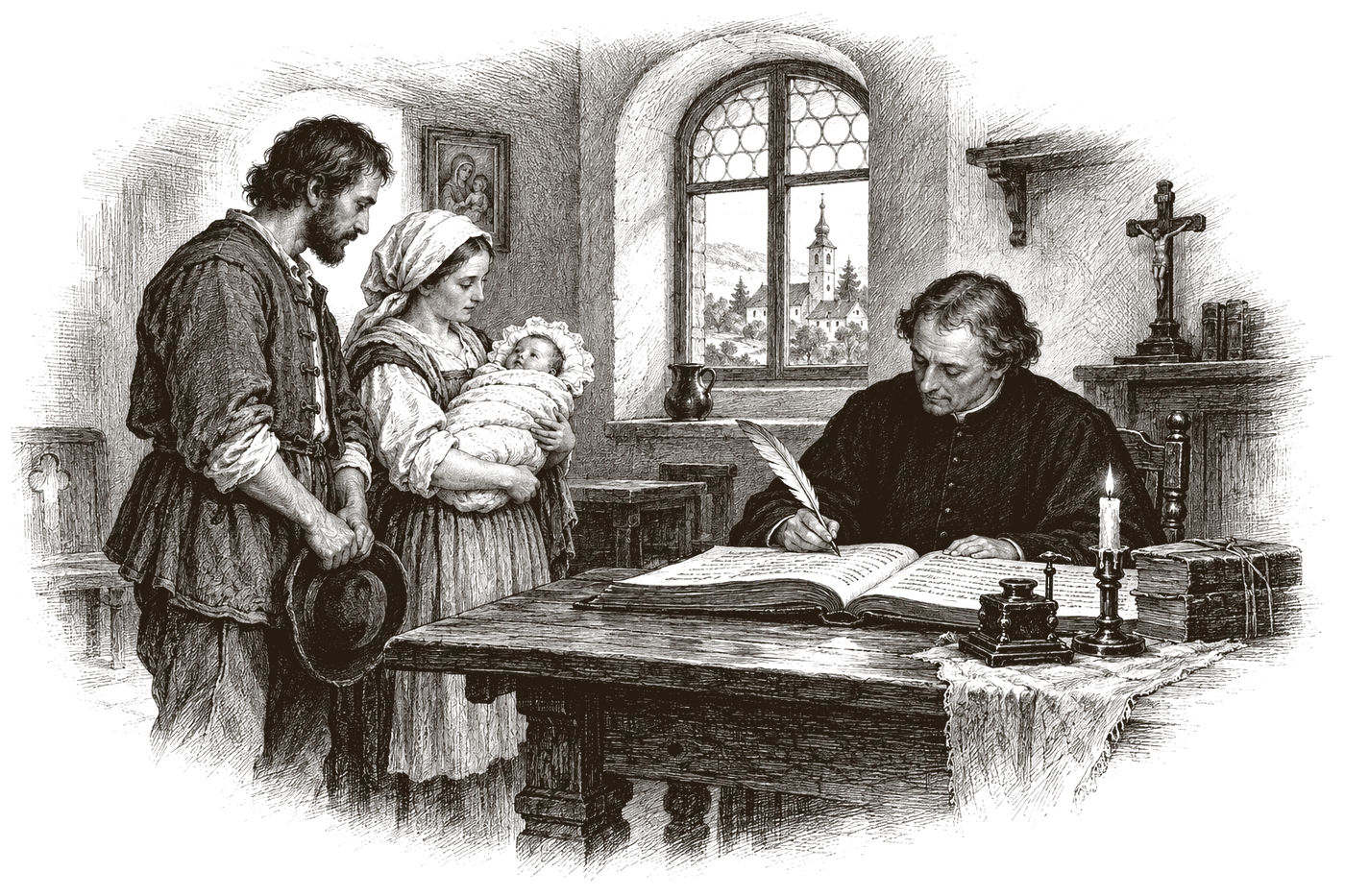
When people in the Czech Republic say "matrika" today, they usually mean the registry office that issues birth certificates. For a family historian, it is first of all a book. A large, heavy book, bound in leather or parchment, its pages filled by the hand of the parish priest. For centuries, three events were written into it, the three things that are certain to happen in every life: baptism, marriage and burial. Almost everything we know about ancestors before 1900 rests on these three kinds of records.
Three books, one priest
The registers were kept by the church, not the state. Every parish had its own books, and the priest wrote into them the people from all the villages that belonged to his church. That is why you do not look for a register by the village where your ancestor lived, but by the parish where they went to church. From a small village with no church, people walked to the neighbouring town to be baptised and married, sometimes over the hill into a completely different manorial estate.
There were three books: of the baptised, of the married and of the dead. In smaller parishes they were at first kept in one volume, divided into sections, or even mixed together as the events came. Note the word baptised. The oldest records do not record births, but baptisms. A baptism usually took place within two days of the birth, because nobody waited, but you cannot read the date of birth from them directly. In the same way, the book of the dead records the day of the burial, not of the death. Both dates came only later.
Who ordered the registers, and when
The Catholic Church was told to keep registers by the Council of Trent. In November 1563 it ordered parish priests to record marriages and baptisms, so that it could be proved whose child someone was and who was already married. The book of the dead was added by the Roman ritual of 1614. In the Czech lands, church councils followed: the synod of Olomouc in 1591 and the synod of Prague in 1605. Protestant congregations had been keeping books even earlier. The oldest surviving register in the Czech lands comes from the mining town of Jáchymov and begins in 1531; the neighbouring mining towns of Horní Blatná and Abertamy have books only a few years younger.
But there was a gap between the order and the practice. By the end of the 16th century many parishes kept books, but many kept them carelessly, and above all: most of those books have not survived.
Why so many registers begin only after 1650
The answer lies in the years 1618 to 1648. The Thirty Years' War devastated the countryside. Villages were burned or abandoned, and many parishes had no priest for years. After the Battle of White Mountain in 1620, non-Catholic clergy had to leave, and their books often disappeared with them. When the parish network was put back together after 1650, priests started new books. The old ones, if they had ever existed, had burned, stayed abroad or simply interested nobody. And what did survive still had three centuries of fires, damp sacristies and removals ahead of it.
Anyone who opens the list of registers of any Czech archive sees the result. In larger parishes the books begin between 1620 and 1660, in smaller ones later, sometimes only around 1700. There are exceptions, and each one is a treasure. The parish of Křtiny near Brno has a book of baptisms from 1607, Pozořice from 1637. The oldest record in our own family tree is from 20 November 1647, the baptism of Ondřej Říčánek of Hostěnice.
How many generations that is
Between 1650 and a person born around 1990 lie roughly twelve generations. If you are lucky with a parish whose books survived and with ancestors who did not move, you can see back to the middle of the 17th century along some lines. Along others the chain breaks earlier: a child born out of wedlock with no father recorded, a soldier, a family that came from somewhere else. That is not a failure of the search. Those are the limits of the source.
What a record from 1659 looks like
Records from the 17th century rarely have columns. The priest wrote sentences as they came to him, in the Moravian countryside mostly in Czech. Here is a marriage record from Pozořice near Brno:
Marriage, Pozořice 1659
Letha Páně 1659 Dne 24 January. Tyto osoby wstaupily w Stav Swatého manželstwí: Waczlaw Šmrda z Šumicz, pogal sobě Halenu děwečku po Nebožtíku Janu Mazowym z Witowicz. Swědkowé gegich byli Thomaš Křížek z Kowalowicz, Mateg Šimša Purgmistr z Šumicz a Jakub Šmrda Rychtář z Šumicz.
On 24 January 1659 Václav Šmerda of Šumice married Helena, a maidservant, daughter of the late Jan Mazový of Vítovice. The witnesses were Tomáš Křížek of Kovalovice, Matěj Šimša, mayor of Šumice, and Jakub Šmerda, village reeve of Šumice.
Moravian Land Archives, Brno, E 67, book 1561, Pozořice 1637 to 1666, image 19, marriages 1659
Notice what the record contains and what it leaves out. There is the groom's name and his village, the bride's name and the name of her late father. There are witnesses with their offices, which suggest that the reeve Jakub Šmerda was probably a relative of the groom. There is no age, no house number (house numbers came only in 1770), and no name of the mother. The spelling is old Czech, the so-called Brethren spelling: w for v, g for j, au for ou. It changed only in the middle of the 19th century. "Pogal sobě" is simply "pojal sobě", that is, he took her as his wife.
A baptism record eleven years younger, from Křtiny, has the same tone:
Baptism, Křtiny 1670
Dne 17 Octobr. Pokržtena gest Dcera gmenem Worſſyla, Martina ſſewcz̈ika, Matky Maryny z Brzezyny. Kmotrowe gegi byly tyto pocztiwe osoby: Symon Pantuček(?) Myſlywecz, Anna Malech(?) ſſenkyrzka, oba z Babicz. Kniez Wylym.
On 17 October 1670 a daughter named Voršila was baptised, father Martin Ševčík, mother Maryna of Březina. Godparents: Šimon Pantůček, gamekeeper, and Anna Malechová, innkeeper, both of Babice. Baptised by the priest Vilém.
Moravian Land Archives, Brno, E 67, book 414, Křtiny, births 1607 to 1695, image 62
The godparents in these records are worth more than they seem. A gamekeeper and an innkeeper from Babice were not random neighbours. Families chose godparents among relatives and friends, and the same pair comes back for several children in a row. When the father's name is spelled a little differently every time, it is often the godparents who confirm that it is the same family.
Czech, Latin, and then German
The language of the record was chosen by the priest. In the Moravian countryside of the 17th century priests wrote in Czech, in towns and among better educated priests in Latin. Around 1700 Latin takes over almost everywhere, and in Bohemia the Prague consistory prescribed it in 1760 as the standard formula. Within one book the language can switch from one day to the next, as the parish of Doubravice nad Svitavou shows. Two children of the same parents, three years apart:
Baptism, Doubravice 1712, in Czech
Februarij 11 | z Strane…(?) | Tobiaß Opatřil, Weruna | Marÿna | Mathiey Dworžak a Kateřina žena Lorence Kružila, oba z Doubrawicze
11 February 1712, from a village whose name is illegible: Tobiáš Opatřil and Veruna, daughter Maryna. Godparents Matěj Dvořák and Kateřina, wife of Vavřinec Kružil, both of Doubravice.
Moravian Land Archives, Brno, E 67, book 286, Doubravice nad Svitavou 1645 to 1731, image 166
Baptism, Doubravice 1715, in Latin
Decembris 1 | ex Pago Zdiar | Tobias Opatřil, Veronica | Barbara | Matthaeus Kužera ex pago Slaup et Catharina ejus Uxor
1 December 1715, from the village of Žďár: Tobiáš Opatřil and Veronika, daughter Barbora. Godparents Matouš Kučera of the village of Sloup and Kateřina, his wife.
Moravian Land Archives, Brno, E 67, book 286, Doubravice nad Svitavou 1645 to 1731, image 177
Veruna becomes Veronica, "wife" becomes uxor, Matouš becomes Matthaeus. The names were translated only on paper; at home people went on using them as before. Anyone looking for ancestors in the 18th century has to know how to look for Jiří as Georgius and later as Georg, for Václav as Wenceslaus and Wenzl. German took over in the registers only after the reform of 1784, even though the decree did not prescribe a language and some parishes went on writing in Czech. We write about the reform in a separate article.
What lies before the registers
The limit around 1650 is not completely impassable. At about the same time the state began to list its subjects for tax purposes. In Bohemia the tax roll called the berní rula was compiled in 1654, in Moravia the land surveys called lánové rejstříky between 1656 and 1679. These are not registers; they have no births and no marriages. They list the farmer, his farmstead (in Czech: grunt) and how many fields he had. The Moravian surveys, and in Bohemia the revision of the tax roll from 1667 to 1682, also give the name of the man who held the farm before him. And that "before him" is the way onward.
In Bořitov near Černá Hora the land survey shows Jakub Wodehnal on a half-size farm (the handwriting is not quite clear; our earlier reading was "Wodenhal"). The clerk recorded him together with his predecessor Lorenc Felix:
Land survey of the Černá Hora estate, Bořitov, 1674
Jakub Wodehnal, vor Lorentz Felix | 10 [Stück] | 23 | 2⅔ | 11 | 5⅓
Jakub Odehnal, before him Lorenc Felix; ten pieces of field, the area in the old measure called měřice, sorted by the quality of the soil.
Moravian Land Archives, Brno, D 1 Land surveys, book 259, Černá Hora estate 1656 to 1674, image 37
And in the oldest Bořitov register, started in 1670, the same Jakub Wodehnal and his wife Alžběta have a son Šimon. A W in front of a vowel was common in the speech of the time; Odehnal and Wodehnal are one family. Two different books, two different clerks and one farmer: the register knows him from 1670, the land survey four years later, and with his predecessor on top. Lorenc Felix held the farm at the first survey in 1656 and 1657, when the Bořitov register did not yet exist. This is how the limit of the registers can be pushed back a little: not by generations, but by the name of the farmer who held the farm when nothing was being written down yet.
Where the registers ended up, and where they are today
From 1781 the registers were officially public books, and the church kept them until 1949. The Registers Act of that year transferred them to the state as of 1 January 1950, and local authorities, today's registry offices, took over. The old books gradually went to the state archives, which have been scanning them and putting them online since the end of the first decade of this century.
For Moravia the registers are in the Moravian Land Archives in Brno (Moravský zemský archiv) and the Land Archives in Opava (Zemský archiv v Opavě), for Bohemia in the regional state archives and the Prague City Archives. Digitised books can be found in their catalogues. We describe how to search them step by step in our guide. And if you would rather start with a finished record than with an empty search box, we will find the first record of one ancestor for free.